If you’re a founder who is exhausted but feels like you can’t switch off, you’re not alone. Running a startup or business is an all-consuming process and comes with a unique set of challenges which makes founders unfortunately very prone to burnout.
As a founder myself, I know first-hand the challenges of this journey. During my career I reached the ranks of CTO and CPO of a games & AI startup I co-founded. I started out absolutely passionate about the project, but over the course of the next two years I found myself completely drained, struggling under the weight of so many pressures and stressors that had built up, and eventually resigned.
That was my third big burnout in my career. Now I work as a burnout coach to share the tools and lessons I wish I knew sooner.
You don’t have to struggle alone. It is possible to achieve sustainable success and reach your goals for your startup. And sometimes we also need to know when it’s time to step away. The most important thing is that you’re protecting your health and wellbeing.
If you’re a founder struggling with burnout and need support, I’d love to help coach you through it. You can book a free introductory call here.
In This Article
Founder burnout often has extra pressures compared to standard burnout. In this article I cover:
What is founder burnout?
Why founders are so prone to burnout?
My burnout as a founder
Founder burnout statistics
The symptoms of burnout
Stopping negative self-talk
The early warning signs of burnout
What happens if burnout is left untreated?
Founder burnout recovery
Solo founder burnout
Co-founder conflict and burnout
Identifying & prioritising your stressors
Time & energy audit
Founder specific tools for burnout prevention
The building blocks of sustainable success
One thing to try this week to help you prevent or recover from burnout
What is Founder Burnout?
Burnout is a state of extreme exhaustion caused by prolonged or repeated stress. The exhaustion can be physical, emotional, mental, or a combination of all three.
While it’s most commonly brought on by problems at work, burnout can be caused by stress in other areas of our lives too such as the cost of living, parenting, caretaking or romantic relationships.
Founder burnout refers to the unique exhaustion people experience while building startups. This role is very high pressure and high stress, while also being high reward if you’re able to reach your goals sustainably.
Why Founders are Prone to Burnout
Founders are incredibly prone to burnout for a number of key reasons. These are the ones most commonly reported in my coaching sessions:
Identity fused with the company. You feel like you ARE the company. When it does well, you do well, but when it struggles, you feel it deeply. Your role becomes your identity. You introduce yourself as a founder, CEO, CTO, CFO even when you’re at non-work events. You slowly forget the other sides of your personality and interests.
No off switch and no one to hand over to. Founders often struggle with delegation or don’t have the funds for headcount to help. As a result we stay switched on all the time, constantly checking emails, Slack, or doing just a little bit of extra work at 11pm. This often means there is no headspace or energy left for other things.
Personal responsibility for your team’s livelihoods - As you start to build a team, it is both a wonderful but daunting experience for many. The weight of responsibility can weigh heavily on founders when you realise you’re now responsible for not only your livelihood, but that of your team.
Financial risk (savings, runway, no salary) - Whether you’re bootstrapping, seeking funding, or watching your runway dwindle, it’s hard to escape from the financial stress of building a business. Many founders sacrifice their own savings and salaries in the early stages in order to help the business get started. In the current economy that is a huge risk to shoulder.
Nobody to be honest with - As a founder you’re needing to show that you’re excited and optimistic about whatever you’re building. I’m sure it started out that way. But over time when challenges come up or you begin to doubt a past decision it can be really isolating because it’s hard to be honest. You can’t always open up to a co-founder, especially if you have any sort of conflict. It’s not easy to open up to investors or the board. Heck, you might not even be truly honest with yourself. Masking like this is exhausting and is a surefire way to a rapid burnout.
Hustle culture treats exhaustion as a badge of honour - Many hustle-culture types will tell you that if you’re not working a 9-9-6 (9am to 9pm, 6 days per week, often seen in Silicon Valley), an 80 hour week or cutting out all other areas of your life to solely focus on your startup, you’re not dedicated enough. There can be massive pressure to overwork to appear like you’re a real founder. But hustle culture rarely leads to long term success. Over time your health and wellbeing will begin to suffer under hustle culture. I am a huge advocate for work-life balance. You can be passionate about your work and still live a full life. In fact, you’ll likely find more success and happiness when you do.
Solo founders can be prone to burnout due to carrying the weight of everything alone.
Do you resonate with any of these areas? Which ones stand out the most to you?
My Burnout as a founder
This feels like a good point to give you some additional context on my burnout journey. I am hoping that by sharing honest insights from my three burnouts it will help you spot any similar patterns in yourself before you hit burnout as hard as I did.
I’ve been in the games and tech industry for 18 years. I solo-founded my first business in 2013 and aimed to build a lifestyle business. I even did the digital nomad thing for a while. Then, while working on a freelance contract for a game industry client had my first major burnout. I didn’t know what was happening and it terrified me. I had been getting sick repeatedly, just small colds to start with but they never seemed to fully hit or go away. Eventually it led to a chest infection. I remember signing in to my freelance work one day and I had a full meltdown. I was overwhelmed to the point of panic and inconsolable tears. I couldn’t look at my laptop screen any more. I had to stop. The doctor signed me off with stress and I had to cut the freelance contract short. It was an awful thing to have to do, especially with a client I loved working with. I felt like a failure, a disappointment to my client, and guilty for letting them down. I was off work for six months while I slowly regained my energy.
My second burnout came years later, this time during employment. Post-pandemic I decided to try full-time employment and took a role as Head of Engineering at an agency. I absolutely loved the work and projects. I got to build amazing things with the team using cutting edge technology and worked with some of the biggest tech and entertainment brands in the world. Unfortunately, my role also required a lot of meetings. I’d have many hours of calls a day, often back-to-back, resulting in a lot of context switching and an inability to take proper breaks. You can’t prepare fully when you’re bouncing from one call to the next. And so I ended up absolutely depleted. I was also working from home, all day every day, so I had very little socialising. Over time I became lonely, isolated, and utterly miserable. I once again started repeatedly getting sick and emotional. This time I noticed this might be a pattern. Still, I didn’t listen and eventually my body forced me to stop again. I went to the doctor and was again signed off with stress. I had to go onto sick pay and decided to resign because I couldn’t see how to fix the issues.
If you’re an ambitious, hard-working person like me, you probably won’t be surprised to hear that I didn’t give myself enough time to recover from that second burnout. I immediately started looking for a new job and very quickly met my future co-founder. Within weeks we decided to build a gaming and AI startup. I went all-in; building prototypes and tech demos to prove our idea was feasible. We hustled hard and managed to secure 7-figure funding. Over the next two years we built a remote team of 12 across Europe, worked with amazing writers for our games platform, and secured yet another 7-figure round.
On the outside, it looked like I was thriving. I was speaking at conferences, travelling regularly to meet exciting people. I had the fancy salary and the nice apartment. It looked like I’d done it; I’d reached the goal many of us strive for.
On the inside though, it was another story. I was crumbling. The pressure of wearing too many hats: co-founder, CTO and adding on CPO later took its toll. I was juggling too many things, many of which could and should have been delegated to new hires. Over time, the stresses in that role built up to the point where I had a panic attack returning to work after the Christmas break. I knew I needed to step away because I was deep in my third burnout. Resigning from your own start-up is one of the hardest things in the world to do. I adored that team. I knew it wasn’t sustainable though and I didn’t think it was possible to solve many of the challenges causing me to burn out. Sometimes the right thing to do is step away.
As Seth Godin would say: you need to identify if this is a dip worth pushing through or if it’s a dead end.
It took me a good six months to recover from that third burnout, and now I am incredibly careful to prevent it.
Since then, I’ve founded yet another business and have thus far avoided a fourth burnout because I have put in place the working practices to protect my wellbeing, working with my energy levels rather than pushing through. I now work as a burnout coach and advisor, using all my hard-won lessons and research to help others struggling with burnout.
Founder Burnout Statistics
My burnout story is unfortunately common. Many people struggle with it and yet unfortunately it’s not talked about much due to the shame, embarrassment and other negative feelings associated with it. People try to push through and avoid it, but this is where we go wrong.
If you’re worried about burnout, or already burning out, please know that you are not alone and you’re not a failure.
The following statistics from numerous surveys and my own conversations with founders, show just how widespread founder burnout is:
Over 50% of founders have experienced burnout in the past 12 months
67% of founders work more than 50 hours a week
88% agree that stress causes bad decisions, which can have a lasting impact on your business
Two thirds of founders have considered leaving their startup
The Symptoms of Burnout
It can be hard to know if what we’re feeling is burnout because the symptoms overlap with other conditions such as anxiety, depression or neurodivergence. If in doubt, it’s always best to get an opinion of a doctor or medical professional.
Here are some of the most common feelings reported in my burnout coaching sessions. How many do you resonate with?
Anxious, Can’t switch off, Cynical, Detached, Depleted, Embarrassed, Emotionally Exhausted, Envious, Failure, Frustrated, Guilty, Helpless, Hopeless, Isolated, Lazy, Lonely, Lost, Mentally Exhausted, Misaligned, Numb, On Edge, Overwhelmed, Physically Exhausted, Resentful, Restless, The house of cards, Trapped, Underwhelmed, Wired but Tired…
I’m going to pick out 3 key ones that come up the most with founders I speak to:
Can’t switch off - Slack, emails, notifications, LinkedIn. It can be addictive to check the apps and we all love the feeling of a like or a nice comment. But when we’re constantly thinking about work, it leaves us little bandwidth for other things: friendships, relationships, hobbies, fitness. When you don’t switch off, other things start to drop off, piece by piece, until one day you notice life just doesn't look how it used to.
Isolated - Who do you talk to when you’re struggling but feel the need to keep up appearances that you and your startup are thriving? Being a founder can be one of the loneliest roles in the world. Speaking to peers, friends or a coach who understands your situation can be a huge help. Please don’t suffer in silence.
The house of cards - When you’re the founder, every decision stops with you. You’re responsible for cashflow, sales, deadlines, keeping investors and the board happy, hiring… So what happens if you want or need to step away? Many of us worry that everything will crash and burn around us if we do. It’s important to avoid the house of cards - ensure you’ve got processes and support in place to carry the company and project so that you can take a holiday or weekend off.
Which of these symptoms do you recognise in yourself?
Stopping Negative Self-Talk
Many of the feelings of burnout are accompanied with a lot of negative self-talk. Founders I speak to often say things like:
“I’m being too lazy, I should do more”
“I feel really guilty for taking the weekend off”
“I’m embarrassed for struggling with this”
“I’m a failure for not being able to work as hard as other people seem to”
We are often our own worst critics but most of the things we say to ourselves aren’t true.
The THINK pattern can really help us in this situation. Next time you say something negative about yourself, try asking if it’s:
True?
Helpful?
Inspiring?
Necessary?
Kind?
Calling yourself lazy, likely isn’t true. Saying you’re a failure certainly isn’t inspiring or kind.
A good rule of thumb for negative self-talk is: if you wouldn’t say it about your friend, don’t say it to yourself.
Early Warning Signs of Burnout
The warning signs of burnout vary for everyone. Mine are getting ill regularly and feeling emotionally overwhelmed. Yours might be entirely different so it’s important to take note of how you're feeling, mentally, emotionally and physically to see if you can spot your own patterns.
Here are some founder-specific warning signs of burnout:
Dreading investor or board updates
Avoiding finances or your inbox
“I’ll just do it myself”
Fantasising about selling or quitting
No longer enjoying what you built
And some common warning signs which occur in people regardless of role:
Being more quiet or subdued than usual
Increased rate of sickness
Looking tired, drained or seeming to have less energy than usual
Feeling sad or emotional
Being more cynical or critical
Lashing out, being grumpy or snappy
Social withdrawal and cancelling plans
Loss of interest in work or hobbies
Saying the performative “I’m fine” when people ask how you are, even if you’re struggling
Difficulty concentrating or focusing.
What Happens if Burnout is Left Untreated?
If left untreated, burnout symptoms can get worse and worse over time and may have a lasting impact on your health and wellbeing. The longer you wait to stop and look after yourself, the longer recovery can take. I often meet founders who have buried their head in the sand for 6-months, a year, or longer and are at breaking point. If they had just stopped and learned to manage their stress, time and energy sooner, they could have prevented burnout or at least made recovery easier.
When a founder ignores the signs of burnout, it increases their likelihood of quitting or being signed off from work. When you are the person the company counts on to succeed, this is the last thing you, or your business needs.
Prevention is better than recovery. And recovery is best started as soon as you notice there’s a problem.
Founder Burnout Recovery
Recovering from burnout starts with acknowledging it is a problem. That is often the hardest part.
From there, the most important thing to do is speak to a doctor or GP - they can help assess how you’re feeling and rule out other causes.
Once you know you are suffering from burnout, there are common steps that help with the recovery (and prevention):
Identifying your stressors and reducing your mental load
Review how you spend your time and energy
Protect the fundamentals of sustainable success
I’ll cover all of these in more detail in the following sections. For now, it’s important to note that stepping back does not mean you’re failing as a founder.
Please also note that recovery isn’t linear. What might take one person months, could take another weeks. Each person’s burnout symptoms and factors are unique to them and it can take a while to untangle them. In my experiences, burnout lasted a solid 6-months before I was capable of working at full capacity, and even now it takes regular management of my stress levels and energy to prevent it returning.
Solo Founder Burnout
Many solo-founders struggle with burnout because they carry the entire weight of the business alone. I personally struggled with this in my first business when I felt like I couldn’t take time off otherwise I’d lose income from freelancing.
If you’re a solo-founder, the steps in this article will help, but I would also recommend prioritising finding peers or a support network so that you feel less alone and have someone to bounce ideas off. It can be very hard to solve problems by yourself when you’re overwhelmed.
Co-Founder Conflict and Burnout
If you have a co-founder and your relationship is struggling under the strain of the business, that can add a profound amount of stress to both of your days. I’ve met many co-founders who decide to go their separate ways; and many more who have worked through their challenges together. A co-founder relationship is akin to a business-marriage. It won’t always be easy or smooth.
For co-founders who are struggling, I highly recommend joint sessions with an advisor or therapist to help you discuss your problems and get them off your chest. Bottling things up is not sustainable and it will cause the stress and issues to compound over time.
Identifying & Prioritising Your Stressors
I mentioned at the start of this article that burnout is mostly caused by prolonged or repeated stress.
Being a founder is exciting but also incredibly stressful. In order to prevent or recover from burnout, the most important first step is to identify your stressors. We need to take note of not only the big obvious stressors, but also the small ones as they compound over time. A daily small stressor can add more cumulative stress over time than a single big stressful event.
Common work stressors for founders:
Long work hours
Unable to switch off
Cashflow, runway & fundraising
Team morale
Hiring, firing & redundancies
Investor relationship
Values mismatch
Co-founder conflict
Personal Stressors:
Relationship issues
Cost of living
Child unwell
Moving house
Car needs servicing
Tax return
Everyone’s list of stressors is different. What would be on your list? Try writing them down and seeing what comes up. This is a process it’s helpful to repeat regularly as the list will continuously change over time.
Prioritising & Solving Your Stressors
Once you’ve made your list of stressors, the next step is to prioritise them. We often think we need to tackle the big obvious problem first, but if you can reduce those small daily stressors, you lower your baseline stress level. This will boost your stress resilience and enable you to handle the big things as they come up.
We prioritise stressors by looking at what is frequent, painful and easy to solve.
We give each of those 3 categories a score out of 3 (1=low, 2=medium, 3=high), then multiply those together to give the priority score.
Here are three examples:
Quarterly investor call
Frequency = 1, Pain = 2, Ease = 1. Score = (1×2×1) = 2
Co-founder conflict
Frequency = 3, Pain = 3, Ease = 1. Score = (3×3×1) = 9
Inability to do the school run
Frequency = 3, Pain = 2, Ease = 3. Score = (3×2×3) = 18
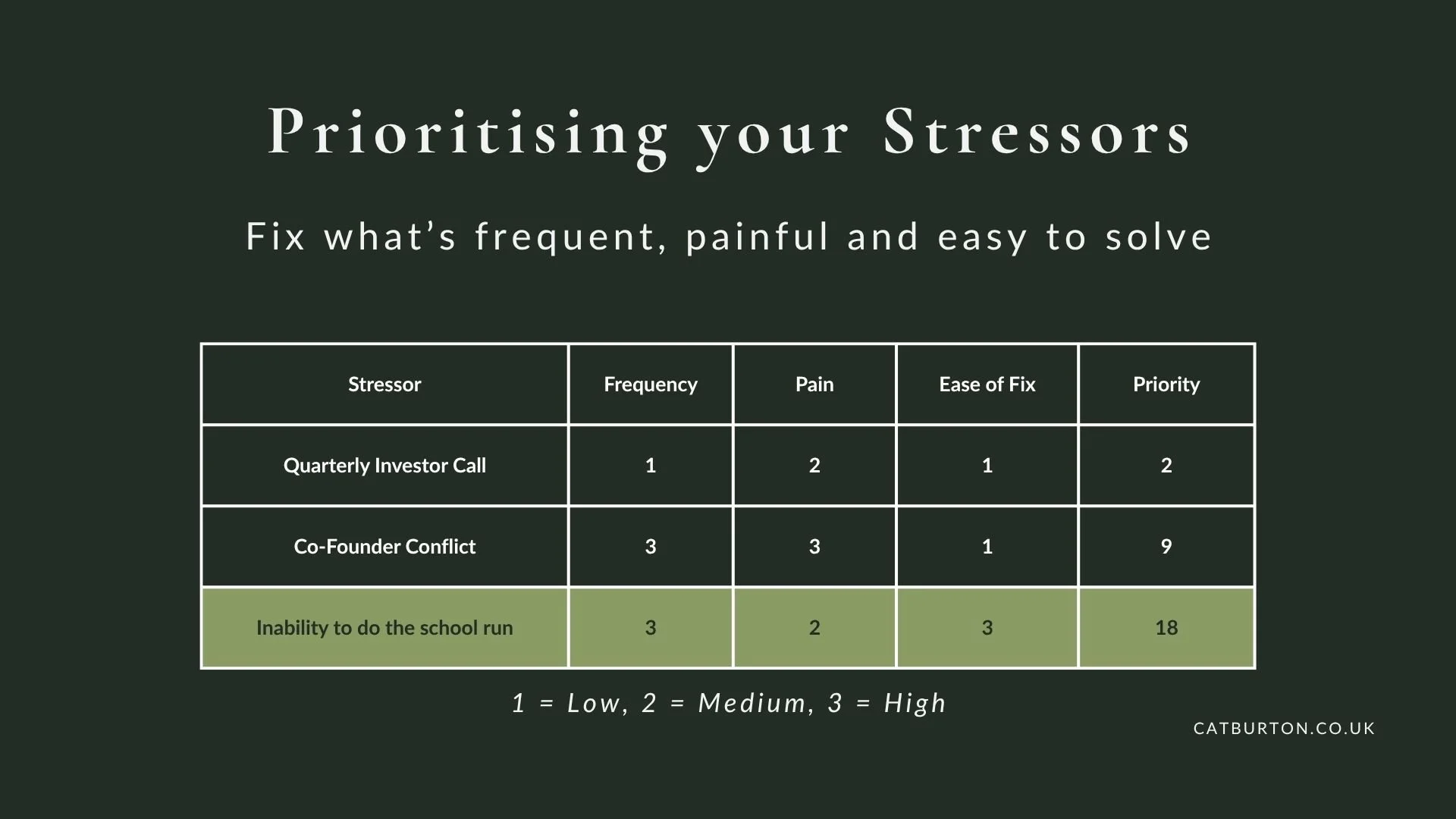
As you can see here, the quarterly investor call might be difficult, but it happens only a few times a year and isn’t easy to fix, so it scores low.
A co-founder conflict can impact you daily, cause significant stress, but might be difficult (or impossible) to solve. In this case it scores a 9. It is still something we’d want to look into, but for now we have easier things to focus on.
The inability to do the school run is a common example I see in founder parents. It can impact them and their children daily and causes pain for the whole family. It’s also incredibly easy to fix. If you’re the founder, you make the rules. You don’t need anyone else’s permission to change the morning to support school runs. Fixing this may also have a positive impact for your team members who are also parents. It’s the first one to fix and gives an immediate daily improvement for multiple people.
Your stressors might look entirely different, so try taking your earlier list and giving them scores. You might be surprised at the recommended priority.
Solving your stressors can be challenging when you’re low energy. You have a few options available to you:
Remove the stressor entirely
Reduce the stressor
Delegate it
Accept it
I generally recommend starting with the smallest positive steps you can. Sometimes you don’t need to solve them entirely, just a small improvement may be enough to get you through a rough time.
Time & Energy Audit
Time and energy are the two resources you can never get back. Use them wisely.
As much as stressors are the main cause of burnout, it’s important to also look at our time and energy usage.
Many of us waste a lot of time and energy on the wrong things, or work in ways that don’t support our natural cycles or brain wiring.
It can help to ask yourself the following questions:
Are you a night owl or an early bird?
When do you have the most energy?
When is your brain clearest and you do your best work?
When is your best time to be active or get outside?
Where are you spending most of your screen time on your phone? Is it constructive?
What can you do to free up time in your calendar so you can block out focus time?
Time and energy go hand in hand because we need to make time for the things that energise us, and give less time to the things that deplete us.
Common energisers for founders I work with:
Attending social or networking events with other founders
Lunch with friends
A walk in the park
Going to the gym
Getting outside
Reading
Playing videogames
The most common energy drains I see in founders, including myself, are:
Masking - whether you’re pretending you’re fine, or you’re neurodivergent, this carries a huge energy cost
People pleasing - many of us are raised without boundaries and find it incredibly difficult to say no. People pleasing might make others happy, but it often comes at the expense of your own happiness and wellbeing.
Energy vampires - Different people have different energies. Some are chatty and extroverted. Others are quieter. Some like to be active all the time. Some like to sit still. Different energies and ways of being doesn't make people bad, but it might make them incompatible with you. We can’t change people or their energies, so if you notice someone drains you regularly, it’s ok to take a step back and protect your energy.
Sedentary lifestyle - we’re still fundamentally cave-people despite how fast the world has evolved. We aren’t built to sit at desks all day in concrete buildings staring at screens. We need to be moving; it’s not just good for our physical health. It’s essential for our mental health and wellbeing.
Phone use and social media - I talk about this topic a lot at events, and recently made my phone into more of a “dumb phone”. Apps and notifications are built to keep us hooked to our phones. They’re programmed to be addictive and give us rapid fire easy dopamine. If you find yourself feeling awful after doomscrolling, wondering where the last hour went, it might be time to check in with your phone use.
Poor sleep - When we are constantly running at 100 miles per hour, our brains don’t get a chance to slow down. Many founders sleep next to their phones or stay up late working and interrupt their usual sleep cycle. We also have a habit of relying on too much caffeine to push through which blocks the signals telling our brains we’re tired. I’ve been there and recently cut out caffeine, seeing a huge improvement in my quality of sleep. Sleep is fundamental to health; when you don’t prioritise good sleep, you will see a big impact on your energy and effectiveness as a founder.
If you think an energy audit might help you, I recommend doing a one-week energy review. Note down everything that drains you, and those that energise you. This will help you begin to spot your patterns.
Founder Specific Tools For Burnout Prevention
As a founder there are many things you can do to help you prevent burnout. Most will be specific to your personal situation and so it may help to work with a coach to problem solve these.
Here are some common tools that help if you need a starting point:
Delegation - you don’t need to do it all yourself. Let go of the reins a bit and slowly build trust in others to carry some of the load
Does it make the boat go faster? - This is a phrase I love from Ben Hunt-Davis’s book. Are you wasting time on the wrong thing? We need to be going at full speed towards our target destination, not getting distracted and slowing down by side-quests. What is your goal? Do your daily activities help you get there?
Plan recovery around predictable peaks - Book days off around hectic things. Speaking at a conference? Rest before it to give you enough energy to perform well. Got a deadline coming up? Make sure you and your team take time off afterwards to recharge.
Regular honest check-ins with a co-founder - This one can be difficult if you have conflict, but speaking to a co-founder can help you identify areas of improvement in how you both run your business.
Speak to a coach, mentor or peers - Just feeling seen or heard, or problem solving with someone external to your issues can be incredibly helpful.
Ask yourself where you are spending your hours? Can you remove some meetings? Can you say no to things that don’t have a net positive?
Add focus time - based on when you have the most focus energy. For me that’s 08:00-10:00. For you it might be 15:00-17:00. Whenever it is, block it in and protect it.
Set boundaries with your phone and notifications. Turn off the notifications that aren’t essential. You don’t need to be nudged for every Slack message and email. You can check them in batches.
Write a handover so the company can run for a week without you
Do a “what truly needs me?” check and see what you can step away from
On a Monday, define your minimum viable week - what is the smallest amount you need to achieve to make this week a success?
The Building Blocks of Sustainable Success
The building blocks of sustainable success are commonly known and simple, yet these are the hardest things to do when you’re depleted and exhausted. When you’re stressed about your business and working hard, these will be the first to get removed from your day.
It is important to bring these back, even gradually, to ensure you’re looking after yourself and able to achieve your goals long term. How many of these have you let slip, and how would you incorporate them back into your week?
Rest & self care
Sleep hygiene
Peers & friends
Turn off notifications
Book that holiday
Stay active
Eat well
Sunlight & nature
Boundaries
Play
One Thing To Try This Week
If you’re struggling with burnout, I’d recommend starting with your stressors. Spend just 10 or 20 minutes and write your current stressors list then prioritise them so you know where to begin. Then you can chip away at them slowly. Even a 1% improvement in your stress levels will grow to a big improvement over time.
Don’t set yourself on fire to keep others warm.
Further Help with Founder Burnout
If you found this article helpful and would like the support of a burnout coach to help you work through the steps and keep you accountable, I would love to help.
You can find details of my burnout coaching here. Sessions are available online to founders in the UK and beyond. I often work remotely with founders from London and across Europe. I also offer in-person sessions in Edinburgh (Scotland). The first step is to book your free introductory call so we can get to know each other and discuss how I can help you. You can book your free call here.
For the VCs, investors and incubators who have read this and worry about their founders, I offer bespoke burnout prevention and recovery workshops tailored to your specific audience. These are available online and in-person. Please see this page for more details or contact me at hello@catburton.co.uk to discuss your needs.
References
Seth Godin, The Dip (Amazon)
https://www.balderton.com/founder-well-being/founder-survey/
My own conversations with hundreds of founders
Ben Hunt-Davis: Will it make the boat go faster? (Amazon)