The Impact of AI on Burnout
No matter who you are, or what industry you work in, AI will have wiggled its way into many areas of your life.
Whether it’s being used at work - Claude, ChatGPT and Gemini seem to be used daily for many people, especially for writing and coding tasks.
Or maybe its in your personal life and apps; the AI results in your search engines; those AI assistants on seemingly every customer service page; and let’s not forget the constant AI slop that has taken over social media.
AI is everywhere and it doesn’t seem to be slowing down.
Another thing that isn’t slowing down are the rates of burnout we’re seeing across the world.
What is Burnout?
Burnout is a state of exhaustion (physical, mental, emotional) caused by prolonged or repeated stress. While it is often brought on by problems at work, factors in our personal lives and the world around us can also add to stress levels.
For a full breakdown on burnout, the symptoms, causes and some general tips for support, see my Introduction to Burnout article.
Burnout Statistics in the UK
I’m based in Scotland, and most of my clients are based in the UK (with a few in the rest of the world). So let’s go with some UK statistics, which are likely similar across other countries:
91% of people in the UK have experienced high stress in the past year (source). With 66% of working mothers being impacted severely by burnout and working fathers (47%) also feeling the strain (source). One in five employees in the UK had to take time off in 2025 due to poor mental health caused by pressure or stress (source).
In a survey by Deloitte, 63% of respondents who were asked about their mental health relating to their work reported symptoms of burnout including: exhaustion, mental distance from their job, or a decline in performance at work (source).
Clearly burnout is a big problem for many people.
And that’s not surprising given everything going on in the world. We’re not just juggling the stress of responsibilities at work and home. Many of us are also worried about the economy, lack of job security, the cost of living crisis, climate change… And even more of us are facing additional stress brought on by AI.
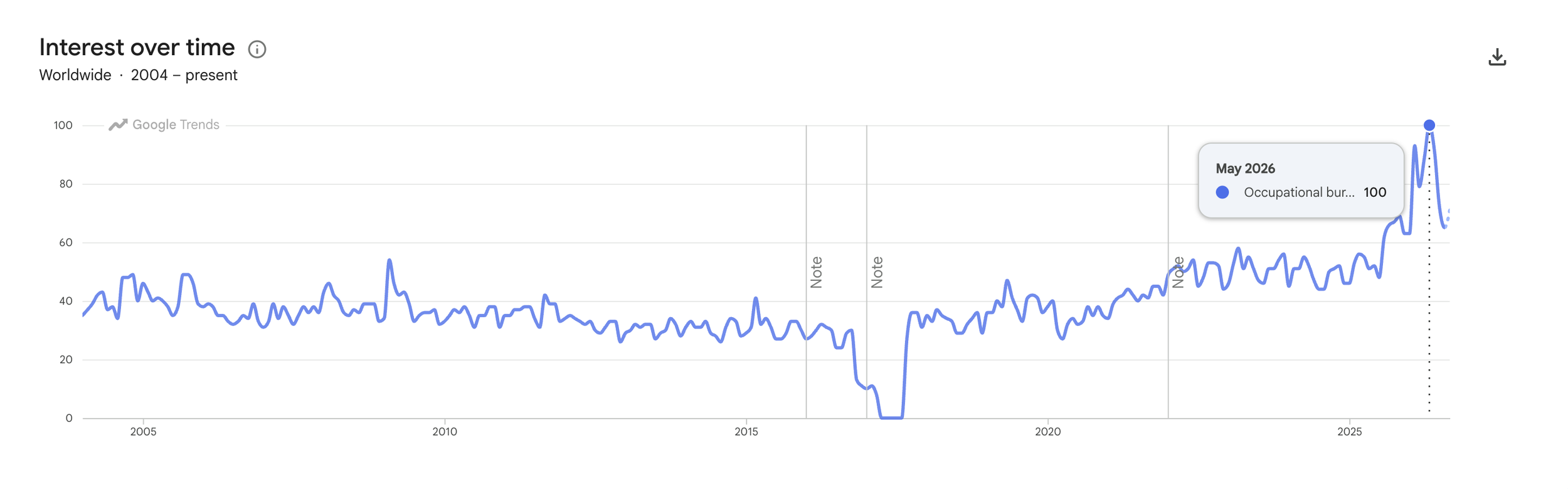
Google Trends data for “occupational burnout”. Note the steady increase post-pandemic, and the huge spike that’s happened since early-mid 2025. (Source)
The Impact of AI on Burnout
So why is AI impacting burnout for many of us?
Let’s start with the elephant in the room: whether you love AI, hate AI, or are somewhere in the middle; it’s having an unprecedented impact and adding various new sources of stress for each of our lives.
This article is definitely not pro-AI. Nor is it anti-AI. I personally believe there is a lot of nuance around AI and its pros/cons. There are some useful applications of the technology (medical diagnosis, scientific research, data analysis etc). Most current uses however, in my opinion, are not helpful or useful, and are a huge waste of resources even before we dive into the ethical debates surrounding the technology.
With that in mind, here are the key ways that AI is adding to our stress levels and increasing the risk of burnout for many people. For each of these I give some tips for how to mitigate the stressor or reduce its long term impact on you. These examples are from my own experience, those of my friends, network and of people at my workshops and conference talks.
Only The Hard Stuff is Left
When work is delegated to AI, in the majority of cases this is usually an LLM, we are often offloading the easy tasks.
At the time of writing, the LLM’s you’re using aren’t really that “intelligent”. They’re very very good auto-completes and word prediction engines. Trained on the internet using common crawl (aka they scraped anything and everything they could find), most LLMs are only capable of emulating what humans are already capable of. Even those complex math problems solved by Open AI - a human could do that; we just haven’t had the time, energy or finances to dedicate time to it. AI has simply solved that problem faster because a big company wanted to dedicate its resources to prove a point and flex its muscles for the sake of a PR opportunity.
So when these LLMs or other AI’s can effectively do what humans are capable of, but much much faster; where does that leave us?
For many people, workplaces are now insisting on AI usage for productivity boosts. Faster, faster is often preferred in business rather than slower, more stable, better for your mental health.
And so people are using AIs to write code.
They’re using AIs to write reports and documents.
All those tasks that are simple, day-to-day, time consuming to do - those are the tasks getting delegated to AI.
And what does that leave us with? The really really difficult tasks. The things someone on the internet hasn’t yet publicly shared a solution for.
We’ve moved from the variety of tasks being low-to-medium-to-high difficulty and lost those simpler tasks that gave us flow or a creative outlet.
For many people their role is one of oversight instead of craft. They’re monitoring numerous AI agents and reviewing their outcomes as they would those of a junior team of assistants.
And what happens when you stop doing the thing you’re good at? That might at times seem mundane or slow, but you could complete and get praise for? We lose the satisfaction. We lose the joy of solving the problem. And we lose the skills we started with.
Who oversees the AIs when the humans lose their basic skills in the role?
So how do we mitigate against this?
Don’t defer or automate the things you enjoy even if AI can do them. I could have asked AI to write this article and it would have written one in seconds. Did I? No. Because I am passionate about the topic of burnout and how AI is impacting people. I want to write this in my voice so that if ever I speak to you, the reader, you recognise my way of speaking and know this is coming from a real life person.
Embrace your unique voice, story, expertise and creativity. In a world of AI slop. Of poorly written generic copy. Of everything looking bizzarely the same. Your individual experiences as a person will become invaluable. An AI can regurgitate words about anything, but it cannot empathise, relate or feel what you feel. I firmly believe that art is made by people - it’s sharing a part of your soul. And in this world of AI, art and craft and artisan products made by people are going to be increasingly valuable. You might not think of your work or role as an artform or craft; but I promise you, your lived experience matters more in your role, your company and your leadership than you might realise.
Keep learning. Our brains are like a muscle; they build neurons where they’re used, and conserve energy where they’re not. It’s why you can learn something at school to pass an exam but struggle to recall it in adult life. Do not let your most valuable skills atrophy by delegating them all to AI. If you’re worried your role might vanish due to AI (more on that later), think about how you can pivot or learn new tangential skills to keep your knowledge up to date and relevant. Never stop learning.
Multitasking and Context Switching
I am increasingly hearing from people who need, or choose, to use AI at work, that context switching is becoming a huge problem. One person likened it to having a browser with far too many tabs open that you’re constantly juggling. Another told me how agentic workflows are causing them to jump from big task to big task; never fully settling into just one or two of them.
Multitasking used to be seen as something almost to brag about. “I’m a good multitasker” meant you could handle multiple things that came up and was a desirable trait in leaders. However, multitasking doesn’t mean you can do multiple things at the same time. You’re having constant micro-switches between the focus that are so quick and imperceptible that you don’t notice them.
Each time you context switch, your brain has to put down all the information from one task and pick up that of another. This takes a lot of mental energy and if you do this too long, or for too many different contexts, it can lead to increased exhaustion and burnout risk.
So what can we do?
Set yourself a goal for a day; with a secondary goal at most. And focus on those goals in chunks of time. You could try the Pomodoro technique to help you with this.
When we focus deeply on one task at a time our quality of work increases and we’re able to get things done faster. As reported in Psychology Today, multitasking might feel like you’re getting more done in less time, but it’s taking more mental energy and usually leads to lower quality output.
Just because computers are multi-threaded; doesn’t mean we are. Don’t fry the CPU in your own head trying to keep up with the machines.
The Impact on Pace and Planning
Trying to keep up with the rate of change and the news cycle around AI is a full time job in its own right. Heck, I was previously Co-founder and CTO at a startup using cutting-edge LLMs as a translation layer to help people make videogames just by writing (using our own modular system of people-made art, audio & game design)…and even with that being my actual job, I struggled to keep up.
If you have a role that’s impacted by AI, whether that’s as a founder, a leadership role, or are someone who is being asked/forced to use AI by your boss for <insert business reasons>, you cannot possibly keep up with everything. Please stop setting yourself an impossible goal of trying to know everything going on in AI world. It’s not possible, even if that is your single full-time task. Trying to do so will exhaust you and add a lot of stress as it’s moving far too fast for any one person to keep up with.
And don’t believe the LinkedIn “gurus”. Those people who claim to be an expert in this or that. There are so many people claiming to be an expert in AI because it’s like a technical gold-rush. The first to the top wins BIG. And so many people are clamouring to appear to be the go-to expert on the topic even though they probably know the same amount as hundreds or thousands of other people on the internet. Don’t fall into the imposter syndrome trap by comparing yourself to someone else’s public posts on the internet. They’re likely as exhausted by it all as you are. You might even know more than them on some niche areas. Avoid the comparison trap, in this case, and in most other areas of your life and it’ll save you a lot of stress.
For anyone who needs to plan; whether you’re a CPO or CTO, a founder, or someone just trying to understand what you’ll be working on in 6-months’ time; it can feel almost impossible to predict. Years ago, we used to have lovely gantt charts; production plans that went years into the future. Many of us could predict technology trends and shifts and know we’d be safe for a certain period of time hunkering down on a skillset.
All of that has changed.
We can’t predict where the AI tooling will be at in 3 months let alone in 6/12/24 months.
So stop trying.
You can’t predict the future; educated guesses yes, but accurate predictions, no. So for now, we need to plan with what we DO know.
What can your tools do now?
What roles are useful in a company now? Which are on the decline?
The world is changing rapidly, and whether we like it or not, AI is here to stay. Be kind to yourself during this transition period and remember that you are a person not a machine. We’re not built to keep up with this ever increasing rate of change.
The Ethical, Emotional and Mental Weight of AI
This one’s a big section. It’s always the biggest area of discussion when I lead workshops on the topic of AI and burnout. So let’s dig into the numerous concerns individually and give them the discussion they deserve.
Copyright Infringement
I mentioned earlier in this article that most modern AIs have been trained using common crawl. This is particularly true for the LLMs, the image generators and the video generators. Common crawl, simply put, is scraping the internet for data and content. Articles, forum posts, artworks, fun videos or animations people uploaded. All of it.
Without their consent. Without a license. Without financial payment.
Now, some content online is open for use without a license. Old work may well be out of copyright. In the UK, the copyright for most writing, art, music, photographs or other creative works is the creator’s lifetime plus 70 years. However this isn’t the same for all work. Plus, some work has been shared online with licenses that allow anyone to use it at any time, even for commercial purposes.
But most of the work used to train AIs does not fall within these exemptions.
Many of us have heard about the $1.5bn settlement Anthropic paid after using pirated books to train its AI models. And while the federal judge in the case ruled that training on copyrighted materials isn’t in itself illegal (as long as correct permissions & licensing are sought); the pirating and method of acquisition of this data was not ok.
All of this is very murky, very muddy, and honestly sits badly with most of us. Including those people who are forced (or feel the need) to use these AI tools.
So what can we do about it? Honestly, the damage has been done, so your options really are to:
Use the more ethical and transparent models - these keep changing, but there are companies who only use fully licensed data sets that do not infringe on IP.
Don’t use AI to create. If your work insists on you using AI but you don’t feel comfortable using it for ethical reasons, I see you. This is a huge stressor for many of my clients and countless people I speak with at conferences & workshops. Your options here will depend on what your work mandates, but you could simply use it as an editor to review your own work. Write your own documents and code. Let AI review it for you. Use your own voice as mentioned above to help you know you’re not stealing someone else’s.
Support artists. Go to your local craft fair. Buy art made by a person. Purchase CDs, Vinyl or gig tickets from your favourite bands. The more we support artists, the longer they can keep creating, so where possible please do this. It’s always been hard to be an artist; the starving artist trope exists for a reason, so do what you can. If you have to use AI at work, it might not offset all of the guilt and stress, but you can help have a positive impact on the lives of people who are heavily impacted by AI.
The Environmental Impact of AI
I am not a climate scientist. The most experience I have with nature and conservation was a time volunteering as a trustee on the board of a countryside trust in Scotland. But you don’t have to be a climate expert to know: the world is heating up. At the time of writing we’re predicted to have the largest El Nino in 1000 years and strongest since records began. We’ve had 5 heatwaves in the UK in 2026 so far with 40 days seeing temeratures over 30C (source), and many of us are worried about the rapid change in our climates that our homes, transport systems, food systems and jobs are just not ready for.
It feels like so much of the talk around climate change and climate policy has taken a back seat since AI became the latest hype in the news cycle.
And then there’s the impact on the environment by AI. Those huge datacentres using up so much land, energy and water. The resources being prioritised for use to make the chips needed in those datacentres which is making them unaffordable to the average person who needs (or wants) a computer to work on, a game console, basic tech.
So how much resources does one innocuous prompt to AI cost? Here is the data from Business Energy UK:
“Using OpenAI’s ChatGPT-4 model to generate a 100-word email alone sweats off more than an Evian bottle’s worth of water (519 millilitres), according to a recent study by The Washington Post (WaPo) and the University of California. And prompting is also a massive drain on the national grid. According to WaPo, the electricity used to generate that 100-word email is equal to powering 14 LED light bulbs for an hour (0.14 kilowatt-hours (kWh)).”
That is a lot of water and energy. And I bet most of your LLM usage is much more than 100 words. I know my past chats have been way longer than that.
None of us are perfect. Many people need to use AI for various reasons, a lot of which may be out of their control. Here are a few things you can do which are within your control:
Only use AI when needed. Don’t rely on it for basic tasks. Turn off AI in your browser and search engine (most will have opted you in without asking). If it’s a task you could do yourself, and it’s not worth spending bottles of water and hours of energy on, don’t use AI.
If you must use an LLM, start a new context window whenever you can, or paste in a summary from a previous chat. This will lower the amount of data and thus the amount of water/energy required to process the request. Remember that in most cases, your entire history in a chat is processed with each new reply, so the impact is worse the longer you use that same chat. A good way to keep track of this is when you hit your usage limit faster. That’s because you’re using up your token allocation (aka data allowance, aka credits) faster due to the increased data being sent. When you hit that notification, use it as a reminder of the environmental impact of all that legacy AI chitchat.
Loss of Psychological Safety
If your work insists you use AI but you personally are ethically/morally against it, what do you do?
How do you raise concerns over the environmental impacts or loss of skills when AI is the latest hype?
What if you absolutely love AI and think it can be a helpful tool but work in a creative industry?
I guarantee that everyone on a team in any business will have a slightly different opinion on AI. Some will like how it makes things easier, others will resent being made to use it. Outside work, your opinions on AI might differ with your friends.
With such a polarising topic it can feel incredibly dangerous to voice an opinion.
Even writing about it in an article such as this can be intimidating as there will always be someone who disagrees.
The most important thing here is to empower people in our teams, companies and friend groups to voice their concerns. Because if people have concerns that aren’t addressed, that adds to their work stress and can lead to them burning out. The more we have open and honest debates about our worries with AI, the more we help others to be brave and state their opinions.
Now as I’ve said, I’m not completely anti-AI. Nor am I pro-AI. I think probably about 5% of the current uses of AI are actually worthwhile, helpful and useful to humaity as a whole. The rest of it is wasteful, pointless and unethical.
It’s hard to take a nuanced stance in a debate that is so polarised. Society wants us to be on one side of the debate or the other. But life isn’t black and white, it’s a fuzzy mess and the only way to get into this topic properly is to have honest conversations.
So founders and leaders, please model this practice in your teams. Open up the conversation and leave room for nuance. Stop wearing the polarised mask, otherwise you may well burn yourself out (masks are incredibly mentally heavy), or your team.
Data Privacy Concerns
I am by no means an expert in data privacy, despite my numerous roles in tech companies and my past life as a CTO. However, I do know one thing: many of us are being more careful with what we post online because we know we can’t take it back. Gone are the blissfully naive days of posting our daily happenings on social media just for our friends to see.
Many of us think about this with social media, and yet so many people are putting very personal information into LLMs. If you don’t know how to turn off their memory or data storage, you don’t know where that data is going or being stored, so please be careful. AI is very much a black box at present, and that is bound to cause issues in the future.
We’ve already seen AI being used to hack platforms such as Hugging Face. How long until we see AI being used to hack other systems?
We’re facing an increasingly huge risk around data security. It’s both a great and awful time to be a security engineer.
So what can we do to help with this big area of stress?
Practice safe data sharing. Only post online, on social media, or into an AI, information which you would share publicly. If you wouldn’t want it seen publicly, don’t type it into an LLM.
If you use AI in your business, make sure someone is responsible for clients’ data and what is fed into AI systems. Check the data usage and storage policies of any AI tools you’re using and make sure data is anonymised as best as possible. You do not want a data breach to happen with an AI system that leaks confidential data about your clients.
If you don’t need AI in your workflow, don’t use it. It’s pretty simple. I don’t use any AI tooling in my emails or documents because I don’t want any details of my connections or clients being fed into AI when I don’t know how or where that data is being stored/used.
The AI Bubble
Will the AI bubble burst? Won’t it? When will it happen?
None of us can answer these questions, but there has been constant debate around whether or not there is an AI bubble and if it will burst over the last few years. Many people thought it would happen in 2026 and we’ve not seen it yet.
If we can’t predict a bubble, what do we do? Many of us are concerned over our jobs, our pensions, the cost of living and this talk of a bubble adds a huge amount of stress to our lives because it all feels so unpredictable.
I am not a financial advisor, so if you’re able, my first piece of advice is to speak to one of them.
My second piece of advice having worked through the 2008 crash is to look at your runway & savings. Both in a business sense if you’re a founder/exec, and in a personal sense. I always try to have 6-months of essential funds available at any given time. Whether that’s my business operating costs, salaries, software licenses etc; or my personal costs such as rent/mortgage, bills, groceries. The amount I budget is for bare-minimum comfort level, no luxuries. What could you and your business survive on for 6 months if you had to? Work out the numbers for yourself and your business, then do what you can now to get there.
A six-month runway won’t solve all your problems, but it’ll soften the blow if/when the economy does take a tumble.
More Productive = More Free Time? Wrong.
Many of us have been in that situation where you have a deadline coming up and you’re working super hard to get things done. Maybe you finish early. Doesn’t that feel great? Yes, but only for a moment, because for most people, finishing a task early does not mean you get to go home or take the rest of the week off from work. There’s always more on the TODO list.
AI exacerbates this problem because it is sold to us as a productivity tool. Everything is suddenly faster, which should mean you get more time back. That’s the lie we’ve been promised. But it’s not happening. The more work you do, the more you get given. And you’re expected to keep up the momentum.
For many people this is adding a lot of stress and pressure because they feel like they can’t slow down or enjoy the feeling of completing something. You don’t get to back in the glory of finishing your work. Instead? More work.
If you’re a founder or exec, it’s easier for you to solve this for yourself and your team. Set goals for the day or week, and when they’re done, that’s it. Don’t add on more. Make your goals something achievable and if you get it done, enjoy that time you’ve freed up. You don’t always have to be going faster and faster. Taking a break will help your brain slow down and you’ll begin the next task with more energy.
If someone on your team finishes early, don’t burden them with more work. Let them finish up for the day a bit early. Or if you can’t do that for some reason, offer them some other reward. If you don’t do this, then why would people work hard to get things done before the deadline. They’d be better off going slow and pacing themselves and handing in the work right at the finish line.
You don’t need to optimise every area of your life or forever chase increased productivity. Remember to slow down and enjoy the process. The journey through life is just as important as the destination.
Tokenmaxxing
Tokenmaxxing is an increasingly popular, but fairly new term. If you’ve not heard of it before, allow me to explain.
When you use a modern AI, the data sent back and forth is split into chunks called tokens. A token is roughly one short word or a sub part of a longer word.
Almost everyone who has used an AI, particularly the popular LLMs, will be aware that at some point you hit a limit - you can’t send any more messages until 5pm, 7pm and so on.
This is because behind the scenes, your data allocation, your credits, are basically a number of these tokens. The more you “chat” to your LLM, the longer the context & history and so each reply takes up more and more tokens. Eventually causing you to hit your usage limit. The more you type in that window, the faster you hit your limit each time as the chat history becomes longer and longer.
So what if you’re using LLMs for work and have become dependent on them? This is where Tokenmaxxing comes in and it’s a particularly negative behaviour that is severely impacting peoples’ abilities to switch off from work.
Tokenmaxxing is when you hit your usage limit with an AI, it says: your allocation resets at 5pm. So you set an alarm and make sure you’re back to continue at 5pm. So far so…weird but not nefarious.
But what happens when your tokens reset at 7pm during dinner with your kids. 9pm when you’re watching Netflix with your partner. 2am when you should be sleeping…
I’ve met many people who set alarms for these times to check in on their AIs and make sure everything is running to maximise their token allocations. It’s keeping them mentally engaged with work when they should be unwinding, resting, spending time with loved ones, sleeping. And naturally, that will have an impact on relationships. It’ll impact your sleep. And over time it’ll lead to diminished mental capacity, which adds to your stress levels.
If you’re resonating with this section, it’s one of the worst issues out there for people using AI currently, so please remember that you don’t need to work outside work hours. If you’re not being paid to log in, don’t do it. If you must maximise your allocations, automate it; there are tools to help with this now. Whatever you do, please don’t get into the habit of logging in at all hours to tokenmax. Your mental health, relationships and sleep will thank you.
The False Price of Tokens
While we’re on the topic of tokens, let’s continue into one of the biggest stress factors for many founders and investors I speak with.
Most AI tools charge by the number of tokens, because that’s the data being processed and that adds to the time/energy costs to process your input. However, it’s widely reported that most of the big AI firms are running at significant losses and not expected to be profitable for years (source). There’s a very interesting site called Is AI Profitable Yet which dives into this in more detail.
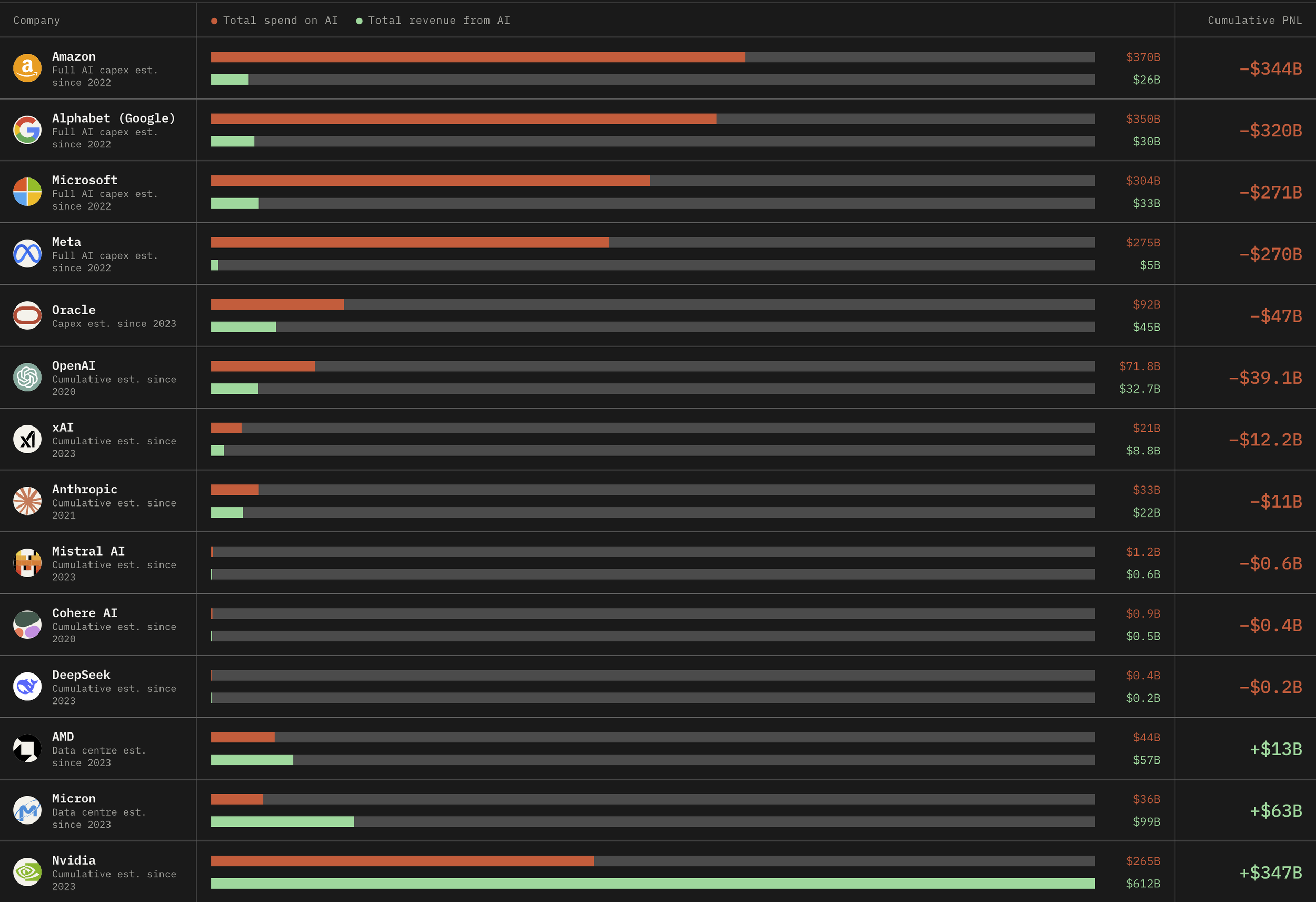
Screenshot from IsAIProfitable.com on 11 Sept 2026 showing the answer is most definitely: No. At the time of writing its a $1.8 trillion total industry spend vs $972 billion revenue.
Effectively the only people making “profit” based on this data are the chip makers - and take that with a huge pinch of salt because that profit is in deals and monopoly money and not cold hard cash. Everyone else, those big tech companies are reported to be running at huge losses in the AI arms race. There are a number of reasons for this, but a key one is that they’re underpricing their tokens to users.
What does this mean? It means many startups, many tech companies, and people in general are building AI into their businesses and day-to-day lives. The companies are betting on you, me, all of us, becoming so reliant on the technology that we have to pay the real prices; whenever that happens.
Realistically, my prediction is that it’s not sustainable for most small businesses and we’ll likely see many pivot to other solutions or unfortunately fold when the prices increase.
For the average user, we’ll likely see more ads and sponsored content as per social media platforms in order to boost revenue for these companies. This will mean the content which is already unreliable (because it was scraped from all internet sources and not fact checked), will become even worse. Just look at what happens to your favourite search engines over time and how they don’t often give you what you want. We’re entering the enshittification era for AI (to borrow a term from Cory Doctorow), and there’s nothing we as the average user can do about that.
So what can we do?
Business leaders and founders - take an honest look at your numbers and the future likely cost of tokens. Does your business income and trajectory scale with the increased cost of tokens? If so, well done, but keep a close eye on it. If it doesn’t; I’d seriously be thinking about how to build your business sustainably. Can you reduce the tokens sent. Can you offset some of your AI use. Heck, a human might very well be cheaper than many peoples’ token bills already, so perhaps we should hire more people again? Wouldn’t that be nice.
If you’re an average user of LLMs, all you can do is be aware that what an LLM gives you isn’t fact. Please fact check anything it tells you. And know that ads and sponsored content are coming. As per social media, this will be based on your interests and what data you’ve given it already, so be mindful of what you type into an LLM and try not to become dependent on it.
The Impact of AI on Leadership Stress
Most of this article is written aimed at founders, execs and leaders. Those of you in the decision-making roles who can make changes and help your teams with their stress levels.
And while I’ve covered some of the broader areas of how AI is causing us stress, I’ve not yet dived into the specific stress impacting leaders.
For many of us, our view on AI is nuanced. Where many see business & investment potential, others see huge issues ethically, morally and environmentally.
Even in a founder role, the use of AI can feel like an inevitable decision, almost outwith your control if you’re seeking funding. So many investors ask about your AI plans and if you don’t have one, your investment options narrow significantly.
But what do you do when your team raises concerns about copyright or the environment? Chances are you have the same concerns.
In some ways you’re damned if you do use AI and damned if you don’t.
Wearing that mask and being in that much internal conflict is exhausting.
Not only that, but leadership is already a particularly lonely role and you can feel really detached from people when you have to champion something while internally being conflicted.
It’s also worth noting the impact of decision fatigue on leaders. For those at the top; the constant analysis of which AI tools and models to use, data security, risk analysis and so on is exhausting. Knowing when is the right time to add these tools, or change/remove them, is a continuous mental load for so many founders.
All of this is adding huge pressure on leaders with stress levels increasing and the risk of burnout being ever present.
So what can we do, as leaders?
Speak to your peers, other leaders in your organisation or at meetups/events. Many supportive and reassuring conversations around the nuance of AI happen behind closed doors if you’re brave enough to enter that room and stand up. Hopefully this article helps you to feel seen if you have conflicting views of AI and are feeling the impact of its stress.
It’s also worth being as honest as you can with your team, and that honesty level varies depending on your role and business. The more you open up to them about the challenging topics, the more you’ll show them that it’s safe to speak up. This boosts psychological safety in the team and helps lower stress levels for them.
And please remember that as a leader, you need to take care of yourself and your own mental health in order to do your job well. Take your holidays; trust your team; and if you are really struggling with the weight of the AI topic, speak to a coach or therapist who can help you find solutions to your personal stressors.
So Where Do We Go From Here?
AI is going nowhere; that genie is well and truly out of the bottle. I do think we’ll see a maturing phase in the coming years and possibly a slow down in the adoption of it as the token pricing settles where it should be. Making AI slop will hopefully become unaffordable for the most part.
If you’re working in AI, or with AI, remember that you can’t possibly know everything about the technology unless that’s your full time role. So cut yourself some slack if you’re struggling to keep up. That’s normal.
And it’s ok if you have to compartmentalise “work you” who is ok with, or even excited by, AI, and “personal you” who worries about the ethics and environmental impacts. Both things are true and nuanced opinions are valid. We all need to earn money and put food on the table; in this economy, don’t beat yourself up if you have to work a job that doesn’t sit quite right with you. You can always put plans in place to fix that at a later date and move to something that better aligns with your purpose and passions.
I Can Help
If this article resonated with you and you’d like support with the stressors around AI or burnout, I’d love to help. You can find details on my coaching services here or feel free to send me a message.
For more general information on burnout, the symptoms, causes and some general tips for support, see my Introduction to Burnout article.
Sources & Further Reading
https://www.mentalhealthfirstaidcourse.co.uk/blog/burnout-statistics
https://www.deloitte.com/uk/en/about/press-room/the-unequal-burden-uk-working-mothers-bear.html
https://www.psychologytoday.com/gb/blog/mental-wealth/202402/the-pitfalls-of-multitasking-at-work
https://www.theguardian.com/environment/2026/sep/03/el-nino-supersizing-before-our-eyes-united-nations - El Nino report
https://www.bbc.co.uk/weather/articles/c99dypl3jgmo - UK heatwaves summer 2026
https://www.businessinsider.com/ai-boom-has-4-bubble-signs-could-burst-2026-economist-2025-12?op=1 - AI Bubble article
https://isaiprofitable.com/ - live statistics on spend, revenue and profits for the big tech companies.
https://www.forbes.com/sites/paulocarvao/2026/05/21/anthropic-openai-enterprise-ai-profitability/ - AI profitability
https://www.businessenergyuk.com/knowledge-hub/chatgpt-energy-consumption-visualized/
https://cybersecuritynews.com/openai-zero-days-hugging-face/
https://link.amazon/B0eSK17SU - Enshittification by Cory Doctorow; an excellent read (Amazon affiliate link)
About Cat
Cat Burton is an executive coach specialising in burnout prevention and recovery. With a career that spans almost 2 decades in the game industry, creative tech and startups, Cat rose to the ranks of founder, CEO, CTO and CPO. While on paper, that all looks great, she spent much of that time repeatedly burning out and struggling behind the scenes. Cat now uses her hard won lessons on burnout, stress management and sustainable success to help other ambitious people who are struggling.